Declared Liability
Changes in the way Move Administer handles declared liability are now complete and with our testers for their comments. When we originally added declared liability to Move Administer we simply removed all insurance fields, however since talking with our users we have made the following changes:
Liability can now be calculated and charged as a percentage of the removal charge. Yep, you did read right, charged!
For example, Move Administer allows you to produce a quotation with a Nett moving figure of £500.00. Let’s say that your rate of liability is 10%, therefore your Liability would be calculated as £50.00. VAT is then calculated on the Nett + Liability, with the Total being the Nett + Liability + VAT.
When the Quotation is printed the customer see’s the basic removal charge at £550.00 + VAT. When the Quotation is accepted the invoice generated will have a Nett figure of £550.00. There is no mention of the £50.00 Liability to the customer.
You also have a checkbox which if ticked will print that ‘extended liability’ has been included, and the extended liability can have it’s own valuation cover that is different to the standard cover on a per product basis (Inland, European, Commercial, etc).
This new way of dealing with Liability allows you, the remover, to claw back some of that lost insurance revenue. And although on the example above £550.00 would be posted to the sales code assigned to the Quotation, Move Administer will have reports to show the breakdown of accepted Quotations, so you can then see just how much Liability revenue was charged in any period, allowing you to adjust your sales turnover figures accordingly.
The ‘new’ liability rate can also be charged for additional services offered, and when it comes to Storage you can charge the Liability as a percentage of the weekly rate or a percentage of the declared valuation.
Fingers crossed that our ‘Declared Liability’ testers find this a great addition to Move Administer.

Wanted!!!
In order to start gathering ideas for Crate Administer, we would be grateful to receive copies of any stationery currently used within your organisation.
Please forward anything you feel we would benefit from seeing, invoices, delivery/collection dockets, etc, to our usual postal address, or better still email them.
Many thanks.
Stationery: Storage Quotations
Here’s a sneak preview of the Storage Quotations.
Each PDF consists of 2 pages consisting of a Quotation and an Acceptance. The Storage Quotations proved a right design challenge to keep inline with our other Quotation forms, as they left lots of unwanted white space!!!
To alleviate this white space we remembered people in the past saying that they would like to type free text notes onto Storage Quotations. So with that in mind we now allow the user to enter Included and Excluded options, just like you can with our other Quotations.
First up is the layout used for those who are regulated by the Financial Services Authority and can therefore offer and charge for insurance cover.
Next we have the layout used for those who offer extended liability.
Comments appreciated, as always.
Web Updating
A new feature was implemented in Move Administer recently, web updating!
Web updating is becoming more and more popular amongst software today, so we decided to jump onto the band wagon too.
Basically, rather than sending out updates of Move Administer on CD, we now upload the latest version to our web server. On the Help menu of Move Administer there is now an option to ‘Check for Update’, and when selected Move Administer will run our web update client, which communicates with our web server to find out if a newer version of Move Administer exists, and if so will ask if you would like to download and install.
The great advantage of our web update client is that it will only download those files that are newer, so although Move Administer currently consists of 40Meg of files, it may only need to download 2Meg of newer files, and even then the files will be compressed using compression comparable with WinZip.
This feature was put into action today amongst our testers and so far so good, with those upgrading finding it a very simple and efficient process indeed.
An enhancement to this which we are thinking of implementing is running the web update client automatically every ‘x’ number of days, alerting the user when a new update is available, rather than waiting for the user to select the ‘Check for Updates’ on the Help menu – but one step at a time eh?
Testing, Testing, 1. 2.. 3…
Since we announced Move Administer back in April we have been inundated with regular calls monitoring our progress from customers of old, and potential new ones to whom we have been recommended (thanks everyone).
Well the finishing line is getting forever closer and I’m pleased to inform you that Move Administer is currently installed and being tested in 7 companies in 8 sites at various locations around the UK (with another being installed this week), re-uniting Richard and I with customers of old.
Testing on Move Administer commenced early in August, and reports to date have been nothing but positive. Many new ideas and enhancements have been forwarded to us, although, and I’m very pleased to add, hardly any bugs, and those reported have only be minor!
Some of the ideas and enhancements have already made their way into the final cut of version 1, and the rest have produced a list as long as my arm, again! This is mainly due to experimenting with new ideas, where those testing would like to take the ideas even further.
Most of our testers have also taken up our offer of converting their current data with great success, which has made testing very easy for them. We currently have a data converter for one of the existing systems available on the market today, with another 3 data converters underway very soon. So, whichever system you may want to jump from, we may have a data conversion solution for you.
We are keeping the names of our testers very close to our chest indeed, as we don’t want to upset the apple cart between them and their current suppliers, but we will announce them in a press release when the time is right.
But, at the time of typing this 2 of the testers are aiming to go ‘live’ on December 1st, with 1 of them running in excess of 25 users!!! YIPEE
Accounting Additions
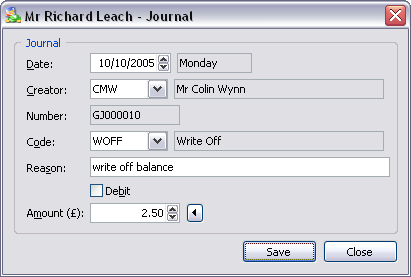
Two recent additions to the accounting Actions menu within Move Administer are; the ability to insert journals and to create late payment charges.
The entry of journals is a welcomed addition to the system, and is the ideal tool for writing off those small account balances that are not worth raising invoices/credits for, and therefore will not affect your turnover reports.
When creating a journal you simply select the type of journal you’re inserting and enter your reason. The journal number is automatically incremented and is easily identifiable on Statements by the use of the letter J.
The late payment charge is inline with the Late Payment Legislation which came into force initially in November 1998, but it was amended in August 2002 to bring additional benefits to businesses (for more information please visit www.payontime.co.uk).
By storing within Move Administer the bi-annual interest rates, together with credit period and compensation charges, at the click of your mouse pointer you can automatically raise an ad-hoc invoice for the interest on the debt, together with a late payment compensation charge.
Interest can charged again and again on an overdue invoice (although you can only charge a late payment compensation charge once), and Move Administer records when interest was charged to on each invoice.
Interest is calculated at the base rate applicable at the time the debt became overdue (usually after 30 days of raising the invoice) plus 8% for the annum. It is then divided by 365 to calculate the daily rate and is charged at that amount for the term of the debt.
I’m sure many of you will find both of these features very useful indeed.